
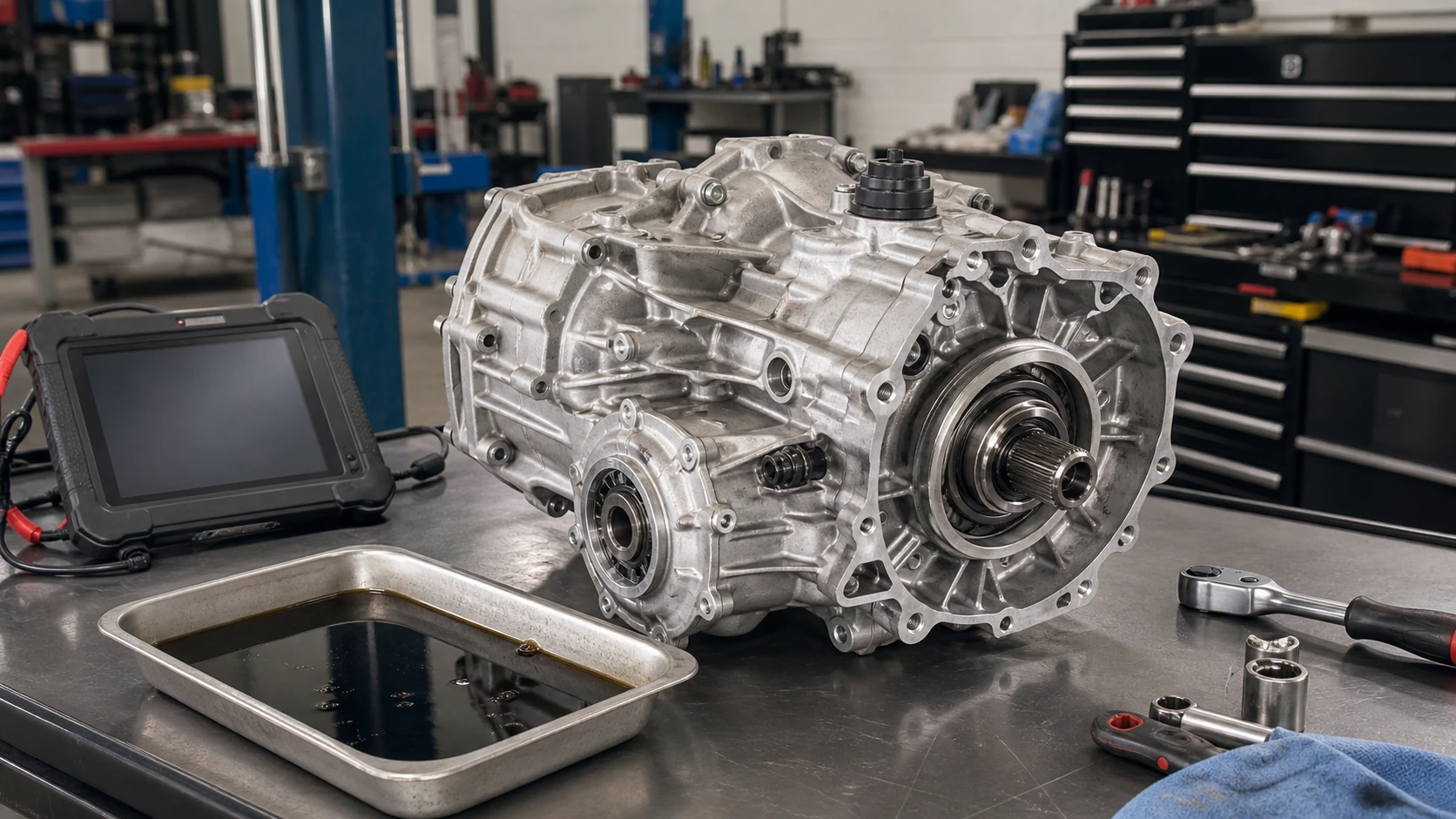
An AWD transfer case sits behind the transmission and routes torque toward the front and rear driveline. Depending on the vehicle, it may use gears, a chain, a clutch pack, a viscous coupling, an electric actuator, or some combination of those parts. Some systems vary torque continuously; others engage the second axle only when control modules detect slip. That variation matters because a behavior that is normal on one model may indicate a fault on another.
What the transfer case does in an AWD vehicle
The transmission provides the selected gear ratio, while the transfer case determines how that output reaches both axles. Bearings support rotating shafts, seals keep lubricant inside, and the correct fluid controls heat and wear. Electronically managed units also rely on sensors, wiring, modules, and an actuator. A fault anywhere in that chain can affect how the vehicle launches, turns, or responds on a low-traction surface.
Before diagnosing a mechanical failure, confirm that all four tires match the vehicle’s specified size and are close in rolling circumference. A substantially different tire diameter forces the front and rear driveline to rotate at different average speeds. On many AWD systems, that difference can keep a clutch pack working when it should be relaxed, raise fluid temperature, and create a bind that feels like an internal transfer-case problem.
Symptom 1: AWD does not engage, disengage, or distribute torque normally
The first warning may be a change in traction rather than a noise. A driver may notice front-wheel spin where the rear axle previously helped, delayed engagement after slip begins, an AWD warning message, or a vehicle that remains locked in a protective operating mode. On selectable systems, a requested drive mode may flash without completing the change.
Possible transfer-case causes include a worn clutch pack, a damaged internal chain or gear, a failed actuator, or low fluid pressure where the design uses a pump. However, the same behavior can result from a wheel-speed sensor, steering-angle calibration, brake-system fault, blown fuse, corroded connector, weak battery voltage, or software issue. Modern AWD diagnosis therefore begins with a complete scan of powertrain, brake, and body modules rather than a generic engine-code scan alone.
Record when the symptom appears. Note whether it occurs only after a long drive, during tight turns, after tire replacement, in cold weather, or under hard acceleration. Those details help distinguish an electronic command problem from a heat-related mechanical fault.
Symptom 2: fluid leak near the center of the vehicle
Transfer-case lubricant may leak from an input seal, output seal, case joint, drain or fill plug, vent, or damaged housing. The fluid can travel along a crossmember or driveshaft, so the lowest wet point is not always the source. Transmission fluid, engine oil, and differential lubricant may also migrate into the same area.
Check the parking surface for fresh spots, then inspect only when the vehicle is safely supported on rated equipment. Look for a wet path above the drip, oil thrown in a circular pattern near a rotating yoke, and accumulated dirt around a seal. Do not crawl under a vehicle held by a jack alone. If the transfer case is noisy, hot, or nearly dry, stop driving it; a minor seal repair can become an expensive internal failure when lubricant is lost.
Fluid color and odor are not reliable enough to identify every product because manufacturers specify different lubricants. Use the exact fluid listed for the model, year, and transfer-case code. A universal fluid that seems similar can change clutch behavior or seal compatibility.
Symptom 3: grinding, whining, clunking, or cyclic vibration
Internal bearings, gears, chains, and clutches can produce noise as they wear. A chain that has stretched may contact the housing under load. A bearing can create a speed-related growl or whine. Excessive backlash may produce a clunk when the driver changes from acceleration to coast.
Noise location is deceptive inside a vehicle. A front CV joint, center support bearing, universal joint, wheel bearing, differential, loose heat shield, or damaged tire can sound as though it comes from the transfer case. A technician may run the vehicle on a lift designed for driveline diagnosis, use chassis microphones, inspect joint play, and compare noise to shaft speed. Guessing from the driver’s seat often leads to replacing the wrong part.
Vibration deserves prompt attention. Stop and inspect if it begins suddenly, becomes severe, follows a recent driveline repair, or is accompanied by a leaking seal. A failing universal joint or loose driveshaft fastener can create an immediate safety risk.
Symptom 4: binding, hopping, or resistance in tight turns
An AWD vehicle that shudders, hops, or feels as though the brakes are applied during a slow parking-lot turn may have driveline windup. An internal clutch can remain applied when front and rear axle speed differentiation is needed. Incorrect or mismatched tires are also a common contributor, as are low tire pressures and different tread depths.
Begin by checking tire size markings, cold pressures, and visible wear on all four corners. Do not assume two tires with the same nominal size have identical circumference if they are different models or substantially different in wear. Then verify that no drive mode intended for loose surfaces has been selected on dry pavement. If those basics are correct, scan the AWD system and follow the manufacturer’s test procedure.
Other warning signs worth recording
- An AWD, stability-control, or service-drivetrain warning that returns after restart.
- A burnt-fluid odor after highway driving, towing, or repeated tight turns.
- Delayed movement or a harsh take-up when shifting from reverse to drive.
- Metal particles in drained fluid beyond the small amount a magnetic plug may normally collect.
- A new leak or vibration after transmission, driveshaft, or differential service.
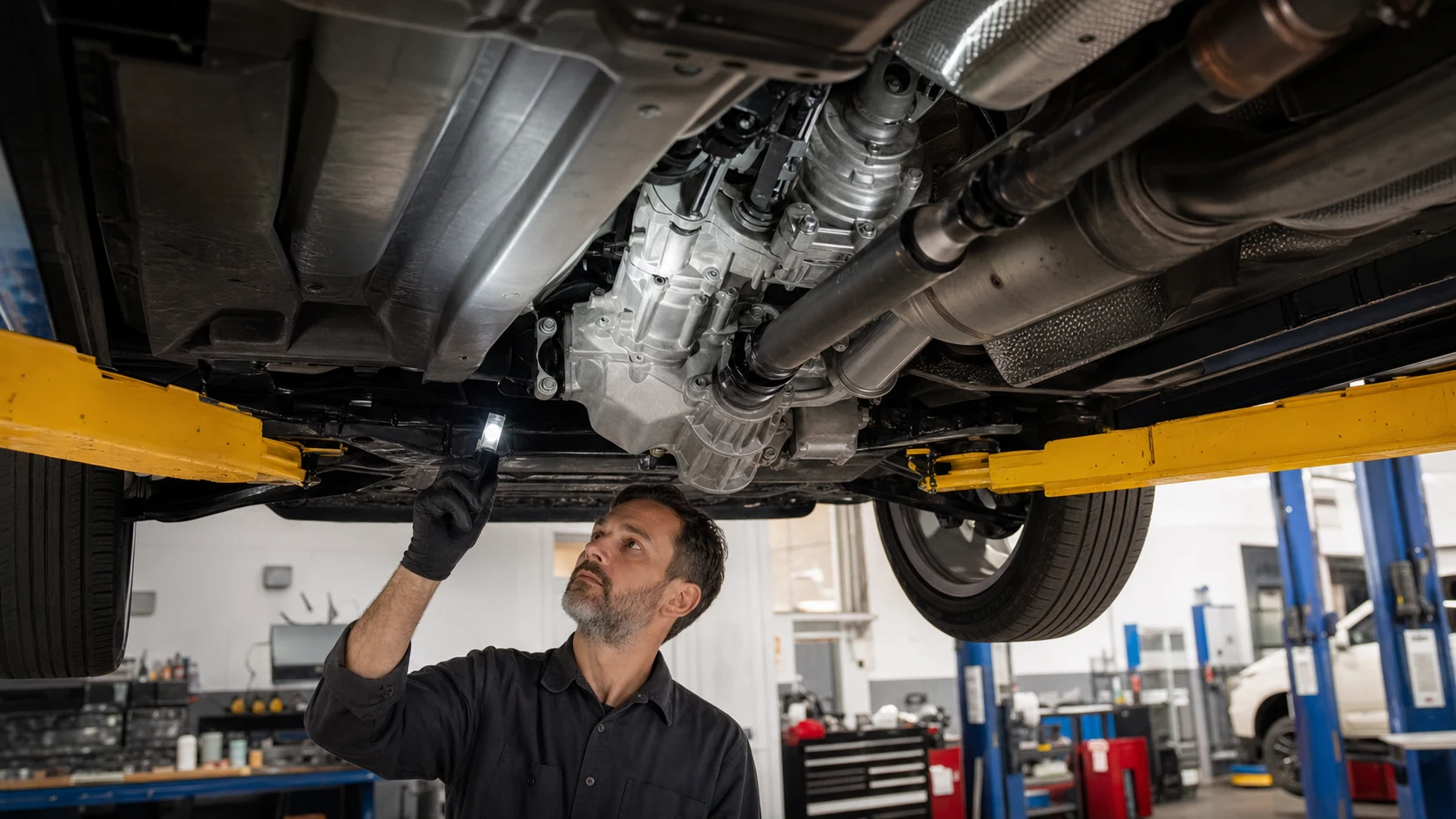
A sensible diagnostic sequence
- Document the conditions. Record speed, temperature, drive mode, steering angle, load, and warning messages.
- Inspect the tires. Confirm size, model, pressure, tread depth, and rolling-circumference compatibility.
- Scan every related module. AWD decisions often depend on data from the engine, transmission, ABS, steering, and body systems.
- Inspect fluid and leaks. Verify level and condition using the specified procedure; some units have no dipstick and require a level vehicle at a defined temperature.
- Inspect the external driveline. Check CV joints, universal joints, shafts, mounts, connectors, and wiring before condemning the case.
- Perform model-specific tests. This may include actuator commands, clutch-current tests, speed-sensor comparison, fluid-pressure checks, or controlled road testing.
Repair, rebuild, or replace?
A leak, failed actuator, damaged connector, or calibration issue may be repairable without replacing the assembly. Internal bearing, chain, gear, or clutch damage may justify a professional rebuild or a remanufactured unit. The right choice depends on parts availability, technician expertise, housing condition, warranty, and whether contamination has circulated through the unit.
If a replacement is needed, identify the unit by vehicle identification number, drivetrain, transmission, axle configuration, and the transfer-case identification tag or code. Similar-looking cases may use different gear ratios, electronics, flange styles, or calibrations. Installation should include the correct fluid, inspected driveshaft joints and seals, verified tire compatibility, and any required adaptation or programming.
When to stop driving and arrange a tow
Do not continue driving simply to see whether a driveline symptom becomes worse. Arrange professional transport when a driveshaft is visibly loose, fluid is pouring from the case, the vehicle binds severely in a straight line, a grinding noise is continuous, smoke or a strong burnt odor appears, or the vehicle loses normal propulsion. Continuing under those conditions can damage the transmission, differentials, shafts, or housing in addition to the original fault.
Before the vehicle reaches a shop, write down recent tire work, collision repairs, towing or off-road use, fluid service, warning messages, and the speed at which the problem begins. Photograph leaks and tire sidewalls if it is safe to do so. Tell the technician whether the symptom changes during turns, acceleration, coast, reverse, or after warm-up. A clear timeline reduces duplicate testing and helps the shop choose the correct road-test and scan procedure.
How to reduce future transfer-case stress
Keep four compatible tires on the vehicle, rotate them at the recommended interval, and correct pressure loss promptly. Follow the severe-service fluid schedule when the vehicle tows, works off pavement, operates in deep water, or spends long periods in extreme temperatures. Repair leaks early and investigate warning lights before repeated driving overheats a clutch pack.
After water crossings, inspect breathers and fluid condition according to the owner’s manual. Never assume an AWD label makes every component suitable for deep-water operation. Also avoid towing the vehicle with driven wheels on the ground unless the manufacturer specifically permits that method; an incorrect towing procedure can rotate internal components without proper lubrication.
Bottom line
Failure to engage AWD, fluid leakage, driveline noise, and binding in turns are four important transfer-case warning signs. None is unique to the transfer case. A careful diagnosis that starts with tires, fault codes, fluid, wiring, and the external driveline protects the owner from an unnecessary assembly replacement and helps catch genuine internal damage before it spreads.