
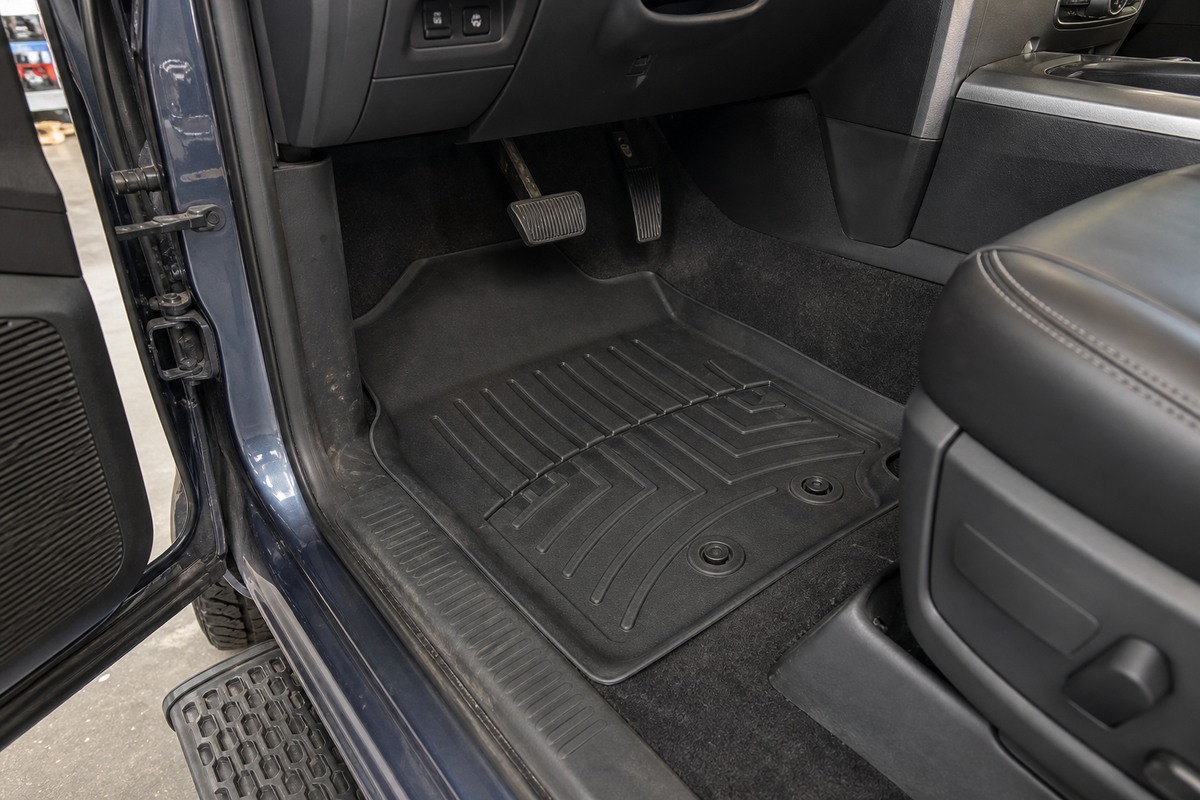
An all-weather floor mat can follow the shape of a pickup cab and still be wrong at the two places that matter most: where it locks to the floor and where its upper edge sits in relation to the pedals. Treat installation as a fit check, not as a simple carpet swap. The useful question is not whether the mat looks tidy with the door open, but whether it stays in the designed position through a full day of entry, exit, cleaning, and pedal use.
The risk is mechanical rather than cosmetic. A safety recall filed with NHTSA described an unsecured all-weather mat moving forward far enough to interfere with accelerator return. That notice concerned specific vehicles and mats, but its practical lesson is broader: the retention system and the rule against stacking mats are part of the fit, not optional finishing details.
Fit starts at the retention points
Park the truck, switch it off, set the parking brake, and move the seat far enough back to see the entire driver footwell. Remove any existing accessory mat instead of laying the new one on top. Vacuum loose grit from the carpet and inspect the factory retention posts or hooks. A missing post, a bent hook, or an eyelet that only rests near the anchor means the installation is not complete.
Match the mat to the exact vehicle application before pressing it into place. Cab floors can change with model year, transmission layout, console design, or an optional pedal assembly even when the outside of two trucks looks similar. Toyota’s current model-specific floor-mat guidance says the mat is designed for the same model and model year, must be secured with the retention hooks, and must not be stacked. That is a better standard than trimming a universal mat or forcing an eyelet over a post that does not align naturally.
Engage every designed retainer and then pull the mat rearward, forward, and sideways with moderate hand pressure. The eyelets should remain seated and the molded perimeter should settle flat against the carpet. A clip that locks only after the mat is twisted is not proof of correct fit. Neither is a single working retainer on a mat designed for two.
Pedal clearance needs a real movement check
Look at the upper edge from the driver’s normal seating position. It must remain below and away from the accelerator and brake pedal mechanisms, including the floor-hinged or suspended parts that are easy to miss from the door opening. Ford’s official floor-mat fitting instructions begin by removing the existing mats, warn that leaving them can interfere with the foot controls, and then require the replacement mat to be positioned under the pedals and locked to the carpet hooks or buttons.
With the engine still off, press each pedal through its normal travel without forcing it. Watch the mat rather than only the pedal face. The edge must not lift, slide, bow, or touch the pedal arm as the pedal moves and returns. If the truck has adjustable pedals, check the normal position used by the driver and then confirm the owner’s manual procedure for other positions. Do not alter the pedal assembly or cut a clearance notch into the mat.
| What you observe | What it means | Correct response |
|---|---|---|
| An eyelet sits beside a retention post | The mat is the wrong application or is not seated | Remove it and verify the exact fitment |
| The new mat lies over a carpeted mat | The retainers and pedal clearance are no longer working as designed | Use one driver-side mat only |
| The upper edge rises when a pedal moves | Pedal clearance is not stable under use | Remove the mat until a correct replacement is available |
Also check the path of the driver’s heel. A molded channel or raised wall can be safely clear of the pedals yet catch a boot and push the mat forward over time. Sit normally, place the heel where it rests during braking and acceleration, and make sure the surface supports the movement without folding or shifting. This is especially relevant with deep winter trays, stiff new rubber, or footwear carrying packed mud.
The installation is not finished after the first drive
Recheck the retainers after the mat has warmed in the cab and again after its first cleaning. Rubber and thermoplastic trays can relax from their shipping shape, while grit under an eyelet can prevent a clip from fully seating. Cleaning is also the moment when mats are most likely to be reinstalled hurriedly, stacked over the original layer, or placed on the wrong side.
Keep the driver footwell free of bottles, tools, charging adapters, and other loose objects that can move under a pedal. The mat cannot compensate for clutter, and a correct retainer does not make a loose object safe. When another driver changes the seat or pedal position, the same short visual and movement check is more useful than assuming the previous setup still provides clearance.
If a retainer is missing, the eyelets do not align, or any edge reaches the pedal area, remove the accessory mat rather than improvising a fastener. Record the truck’s model year, cab configuration, and the mat’s exact part identification before seeking the correct replacement. A properly fitted floor mat should disappear into normal driving: one layer, every retainer engaged, and clear space around every pedal through its full movement.