
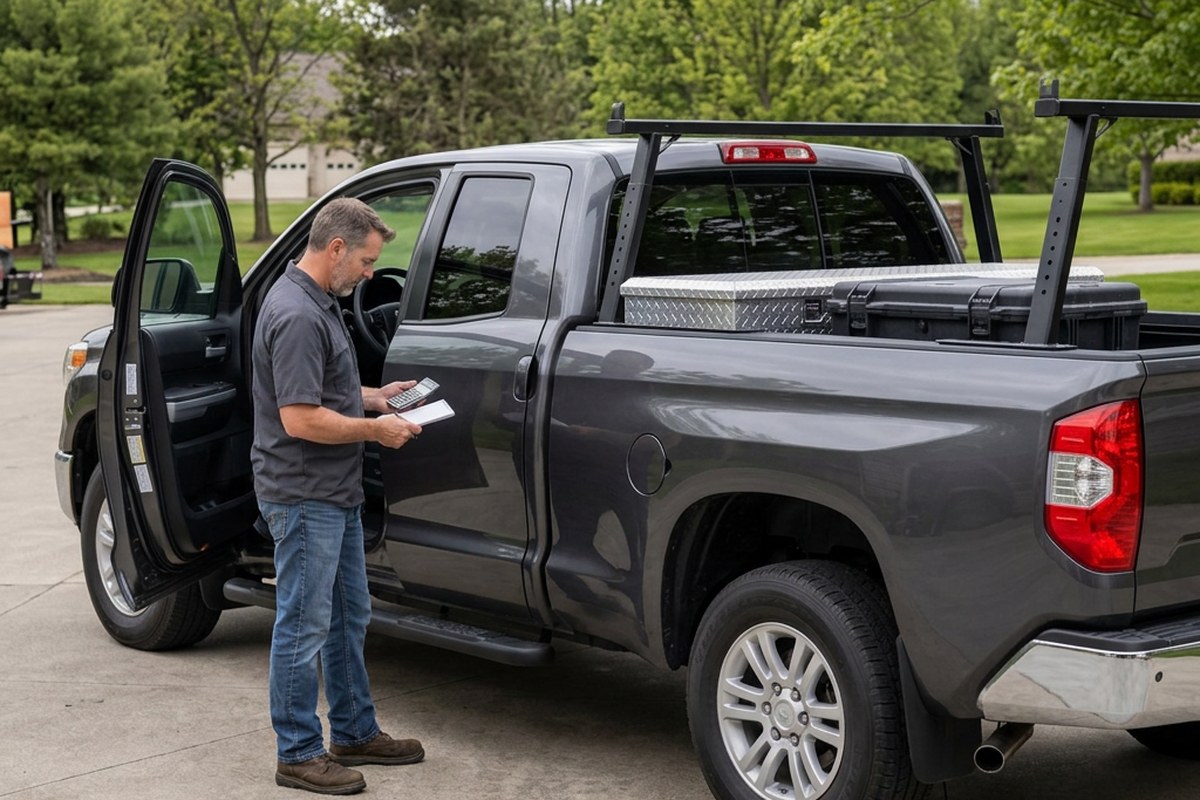
A bed rack, cross-bed toolbox, recovery gear and a weekend load can look modest when each item is considered alone. The problem is that a pickup does not give each accessory its own allowance. Every fixed part, occupant and piece of cargo draws from the same vehicle-specific payload budget.
The useful starting point is not a brochure’s maximum claim. It is the label set on the actual truck. The federal certification-label rule requires the manufacturer to state the gross vehicle weight rating and axle ratings, while NHTSA’s tire-and-loading placard explanation covers the combined occupant-and-cargo limit. Read both before ordering hardware, because trim, cab, drivetrain and factory equipment can make two outwardly similar trucks carry different numbers.
The truck carries two related limits
The tire-and-loading placard usually gives the clearest everyday number: the combined weight of occupants and cargo must not exceed the stated amount. That budget has to absorb people, luggage, tools, bed accessories and trailer tongue weight. A rack or toolbox does not stop counting because it is bolted down.
The certification label adds GVWR and front and rear GAWR. GVWR limits the complete loaded truck. Each GAWR limits what its axle can support. Staying below the occupant-and-cargo figure is necessary, but it does not prove that the rear axle is within its rating after a heavy toolbox, rack load or trailer tongue load is concentrated behind the cab.
Ford’s towing definitions describe payload as the combined allowable weight of cargo and passengers. Other manufacturers use the same underlying idea even when the door labels and towing guides are formatted differently. Use the truck’s own labels and current owner’s manual as the controlling sources.
Turn every accessory into a debit
Write down the installed weight of each permanent or semi-permanent addition. Include mounting brackets, clamps, drawers, dividers, spare hardware and any gear that normally stays inside the box. Product shipping weight can include packaging, so use the manufacturer’s installed-weight specification when it is available and weigh uncertain assemblies rather than guessing.
A practical payload budget has four groups: fixed accessories, people, ordinary cargo and task-specific load. Fixed accessories might include a rack, toolbox, bed slide or auxiliary tank. People include the driver and passengers. Ordinary cargo is the gear that lives in the truck. Task-specific load is whatever changes for this trip, including materials on the rack and trailer tongue weight.
This is also the point to question accessory overlap. A deep cross-bed box may conflict with a tonneau cover, reduce clearance for a sliding tray or move bulky items behind the rear axle. The site’s wheel-well toolbox guide shows why usable bed space and installation layout matter alongside product capacity.
A worked budget before drilling the bed
Assume an example pickup’s placard allows 1,650 pounds for occupants and cargo. The figures below are illustrative, not a rating for any real model. They show how quickly separate purchases become one load.
| Payload item | Example weight | Budget remaining |
|---|---|---|
| Starting placard allowance | 1,650 lb | 1,650 lb |
| Bed rack with mounts | 120 lb | 1,530 lb |
| Cross-bed toolbox | 110 lb | 1,420 lb |
| Driver and passenger | 360 lb | 1,060 lb |
| Tools and recovery gear | 180 lb | 880 lb |
| Weekend cargo on rack and in bed | 300 lb | 580 lb |
| Loaded trailer tongue weight | 450 lb | 130 lb |
The remaining 130 pounds is not a target to fill. It is a narrow margin that can disappear with a third passenger, firewood, water, a heavier hitch component or an optimistic accessory weight. If the calculation is close, reduce the load or choose lighter equipment before installation.
Rear-axle loading can become the tighter constraint
Payload calculations are totals; trucks carry weight at specific locations. A toolbox near the cab and a rack load centered over the bed do not affect the axles exactly like passengers between them. Cargo placed far behind the rear axle can add rear-axle load while taking weight off the front axle. Trailer tongue weight also acts through the hitch at the back of the truck.
That is why a sound plan compares the loaded truck with GVWR and both axle ratings. Chevrolet’s current trailering guide notes that passengers, cargo and equipment count in the vehicle limits and presents vehicle-specific trailering information at the driver-side door jamb. The same discipline applies to a pickup that is not towing: labels and actual weights outrank a generic model-page maximum.
When the truck carries a recurring work or travel load, weigh it in that normal configuration. Record the total and individual axle weights from a suitable scale ticket, then compare them with the exact labels. A scale check catches assumptions that a spreadsheet cannot, including extra gear, a heavier-than-listed installation or an uneven load.
Repeat the calculation after installation
Keep the final accessory receipts and specifications with a simple weight record. After the rack and toolbox are installed, confirm that doors, drawers and the tailgate move freely; mounting hardware follows the manufacturer’s instructions; cargo cannot contact the cab; and nothing blocks lights, cameras or the center high-mounted stop lamp.
Load the truck as it will actually travel, not as an empty showroom display. Count the people who will be inside, the tools that stay in the box, the cargo carried above the bed and any trailer tongue load. The site’s pre-towing walk-around is the next check when a trailer is part of that configuration.
A good accessory plan ends with a number that still works after installation. If the budget depends on ignoring mounting hardware, passengers or the gear that makes the rack useful, the setup is not finished. Change the load, choose lighter components or change the vehicle configuration before the first loaded trip.