
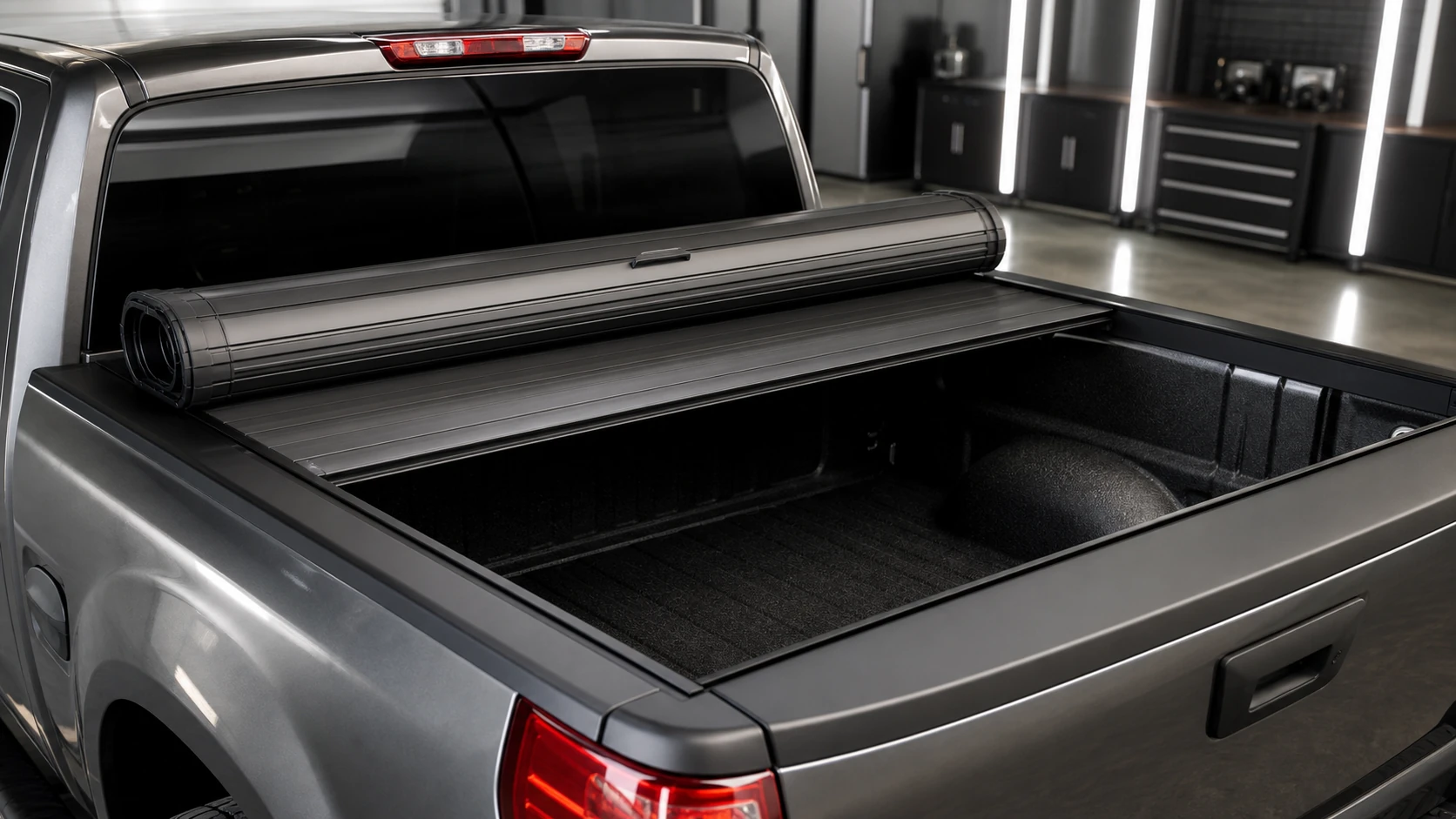
A hard-rolling cover appeals to owners who want the bed nearly open without stacking folding panels against the cab. When rolled toward the cab, it occupies a compact area near the front of the bed. When closed, the slatted structure offers more resistance to casual intrusion than a typical unsupported soft vinyl sheet. Those benefits come with tradeoffs: precise rail alignment matters, the roll still occupies some space, and no tonneau cover turns a pickup bed into a fully waterproof or vault-like compartment.
How a hard-rolling tonneau cover works
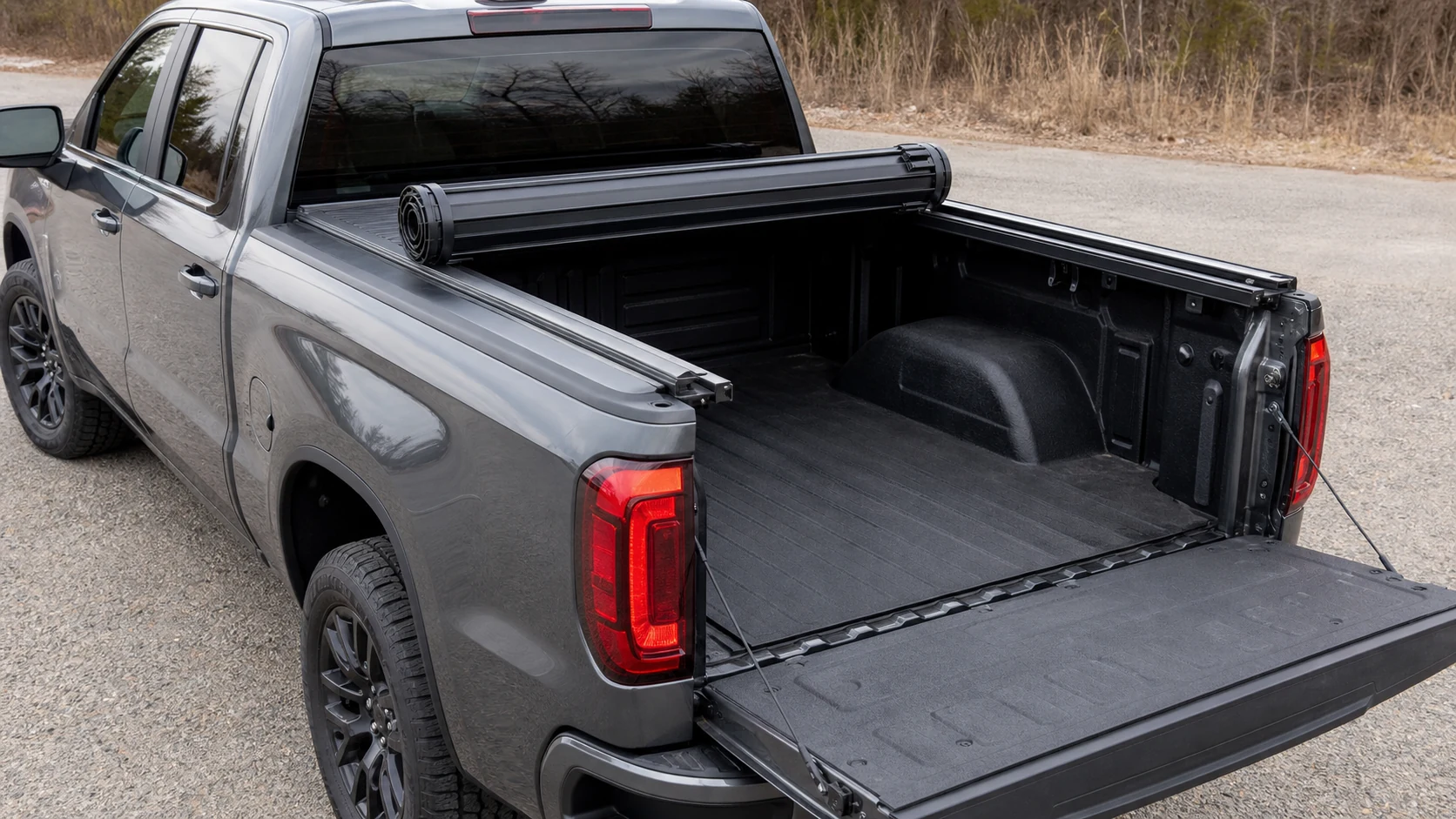
The cover rides on truck-specific rails clamped inside or along the bed sides. Narrow rigid slats are joined so the assembly can roll while remaining comparatively firm when laid flat. A surface layer protects the slats and creates a continuous appearance. At the tailgate, latches secure the closed cover to the rails. Opening usually begins by lowering the tailgate, releasing a latch cable, and rolling the assembly forward.
The exact arrangement varies by product generation. Some rails occupy more interior bed width than others. Drain tubes may route water from the front corners. Seals may contact the bulkhead, bed caps, or tailgate differently. That is why a photo of a Revolver-style cover on one truck does not prove it will fit another truck with the same badge but a different model year, bed length, factory cargo system, or bedliner.
What made the Revolver X2 format useful
The original appeal was not a single marketing claim but the combination of everyday functions:
- Broad bed access. The cover rolls toward the cab instead of leaving several panels stacked over the rear portion of the bed.
- Low profile. A correctly installed rail system sits close to the bed caps and avoids the tall look of older snap-style covers.
- No large panel against the rear window. This can preserve rearward visibility compared with a folding cover secured upright, although the rolled bundle still needs to be tied down correctly.
- Rigid support beneath the surface. Interlocking slats make the closed cover more resistant to simple lifting than unsupported fabric.
- Tailgate-controlled access. On many applications, closing and locking the tailgate blocks normal access to the release mechanism.
These characteristics remain relevant when comparing an X2 with another hard-rolling design, but fitment, materials, and hardware must be confirmed in the manufacturer application data for the exact cover generation.
Fitment comes before features
The correct cover is determined by more than the truck’s make and model. Verify all of the following:
- Model year and generation.
- Exact bed length measured inside the bed, not the truck’s overall length.
- Cab and body configuration where the application guide uses them.
- Factory bed-rail, cargo-management, or utility-track systems.
- Presence of a factory or aftermarket drop-in bedliner.
- Stake-pocket accessories, ladder racks, cross-bed toolboxes, sport bars, and bed caps.
- Powered tailgate or unusual tailgate trim that may affect seal contact.
Two pickups described casually as a “short bed” can require different covers. A part number intended for one generation may be only slightly different in length or rail geometry, yet that difference can prevent the latches from engaging safely. Use the cover manufacturer’s current application guide and verify the selected part number on the order confirmation.
Bedliners, racks, and toolboxes
A spray-in liner usually causes fewer fitment problems than a thick drop-in liner, but material around the clamp points may still need attention. Do not trim a liner until the installation instructions explicitly identify the permitted area. Cutting too much can expose the bed or leave a permanent gap if the cover is later removed.
Most standard hard-rolling rails share the upper bed area with other accessories, so compatibility cannot be assumed. A rack designed to use stake pockets may work if its uprights clear the cover and roll. A toolbox positioned across the bed usually conflicts with a full-length cover unless a dedicated toolbox-compatible system is specified. Check both products’ instructions; “fits with most racks” is not enough information for a safe purchase.
Installation details that affect performance
A hard-rolling cover is not difficult merely because it uses clamps, but accuracy matters. The bulkhead seal must contact a clean, correctly prepared surface. Left and right rails need to be parallel and at the specified height. Clamps should be placed where the rail and bed structure can support them, then tightened in the sequence and torque range in the instructions.
If the rails narrow toward the tailgate, sit too low, or twist, the cover may roll unevenly, unlatch poorly, or wear its edge seals. Before driving, cycle the cover several times, confirm both latches engage, secure the rolled cover with its retention straps, and check that no strap or cable can contact moving cargo or the rear window.
After the first drives and after large temperature changes, recheck clamp security and alignment. Polymer seals and surface layers can relax after installation. Correcting a slight rail shift early is easier than continuing to force a misaligned latch.
Water management and weather expectations
Tonneau covers are weather-resistant, not sealed passenger compartments. Water can enter around the tailgate, stake pockets, bed seams, damaged seals, or a poorly prepared bulkhead. Drain tubes only help if they are routed without kinks and terminate where water can leave the bed.
To evaluate an installation, use a gentle hose flow rather than a pressure washer. Start at the front and work rearward while another person observes the bed. Mark the entry point before moving seals. A small tailgate gap may need truck-specific weather stripping; an evenly wet front edge more often points to bulkhead preparation or rail alignment.
Security in realistic terms
A rigid rolling cover can hide cargo and discourage quick access when the tailgate is locked. It should not be described as theft-proof. Hand tools, damage to the cover, or access through a compromised tailgate can defeat many bed covers. Keep high-value items out of sight, use additional secure storage when appropriate, and confirm that the vehicle’s tailgate actually locks.
Inspect the surface and latches after an attempted break-in rather than continuing to operate a damaged cover. Bent slats or rails can interfere with complete latching, and a partially secured roll can become hazardous at highway speed.
Daily operation and cargo planning
Before rolling the cover closed, make sure cargo does not sit above the rail line or press against the slats. Sharp or shifting objects can damage the underside. When the bed must carry a tall load, roll the cover fully to the cab and fasten every retention strap. Never leave it partly rolled and unsecured.
Account for the rolled bundle when positioning a motorcycle, refrigerator, or other tall load. The bundle occupies less bed length than many folded stacks but still needs clearance. Protect the rear window, keep tie-downs independent of the cover hardware, and follow the truck’s payload and cargo-securement requirements.
Maintenance that preserves smooth operation
- Wash grit from the surface and rail channels with mild automotive soap.
- Use only cleaners and protectants approved for the current cover material.
- Keep latch cables moving freely and inspect them for fraying or misrouting.
- Clear leaves and debris from drain inlets and tubes.
- Check clamps, end caps, seals, and retention straps at oil-change intervals.
- Remove heavy snow rather than operating the cover under a packed load.
Do not apply a random petroleum lubricant to rails or seals. It may attract abrasive dirt, swell rubber, or make the cover unsafe to grip. Follow the care instructions for the exact generation.
Evaluating a used or discontinued X2 cover
A used hard-rolling cover is worthwhile only when its original truck application can be verified. Measure the assembly and rails, locate every part-number label, and compare the hardware with the installation manual. Missing clamps should be replaced with specified components rather than generic hardware. Inspect the slats for bends, the surface for separation, the latch cables for fraying, and the rails for deformation around old clamp points.
Confirm that replacement seals, latches, straps, and end caps remain available before buying. A low purchase price can disappear quickly if the cover needs generation-specific parts. Never shorten rails, drill new latch holes, or mix left and right hardware to force an application. A cover that cannot latch evenly on both sides is not ready for road use.
Should a current buyer choose a hard-rolling cover?
A hard-rolling design remains a strong choice for a driver who frequently opens most of the bed, wants a low profile, and does not want a large folded panel against the cab. A hard-folding cover may suit an owner who prefers sectional operation or regularly opens only the rear panel. A soft roll-up can be lighter and simpler, while a retractable cover offers different convenience at the cost of a canister that consumes bed space.
Compare the current hard-rolling products by verified truck fitment, rail intrusion, replacement-parts availability, warranty terms, surface care, and compatibility with other accessories. The Revolver X2 showed why the format is useful; the best purchase today is the current, truck-specific system whose documentation matches the way the bed will actually be used.