
Short answer: a running board sold for a Ram 1500 should not be assumed to fit a Ram 2500. The trucks may share a brand name, cab description, and similar-looking step, but the application still depends on the model year, body family, cab length, mounting-point pattern, and the bracket kit supplied with the board. A safe purchase starts with the complete application table and installation instructions, not a photo or a broad “fits Ram” claim.
Updated
The quickest way to avoid a return is to write down five details before shopping: the exact model year, 1500 or 2500 series, cab configuration, bed length when the board runs past the cab, and whether the truck has fixed or power steps. Then compare those details with the manufacturer’s current application guide and the part number printed on the board and hardware package.
Ram running-board fitment at a glance
| Fitment check | Why it matters | What to verify before ordering |
|---|---|---|
| Truck series | A 1500 and a 2500 use different body and mounting systems even when the cabs look similar. | The listing must name the exact series. Do not treat “Ram Crew Cab” as a complete application. |
| Model year and body family | A generation change can move the mounting points or require a different bracket shape. | Match the year range and any Classic, new-body, or heavy-duty designation shown by the manufacturer. |
| Cab configuration | Regular, Quad, Crew, and Mega Cab bodies do not share one universal board length. | Confirm the cab exactly as it appears on the vehicle record and application chart. |
| Board coverage | Cab-length and wheel-to-wheel steps are measured for different purposes. | For wheel-to-wheel boards, confirm both cab and bed length. |
| Bracket and hardware kit | The visible board can look identical while the brackets, rivet nuts, reinforcement plates, and bolt spacing differ. | Require the complete kit part number and the installation sheet for that part number. |
| Fixed or powered operation | Power steps add motors, hinges, wiring, controls, and a defined stow position. | Confirm electrical compatibility and the complete left/right assemblies, not only the step surface. |
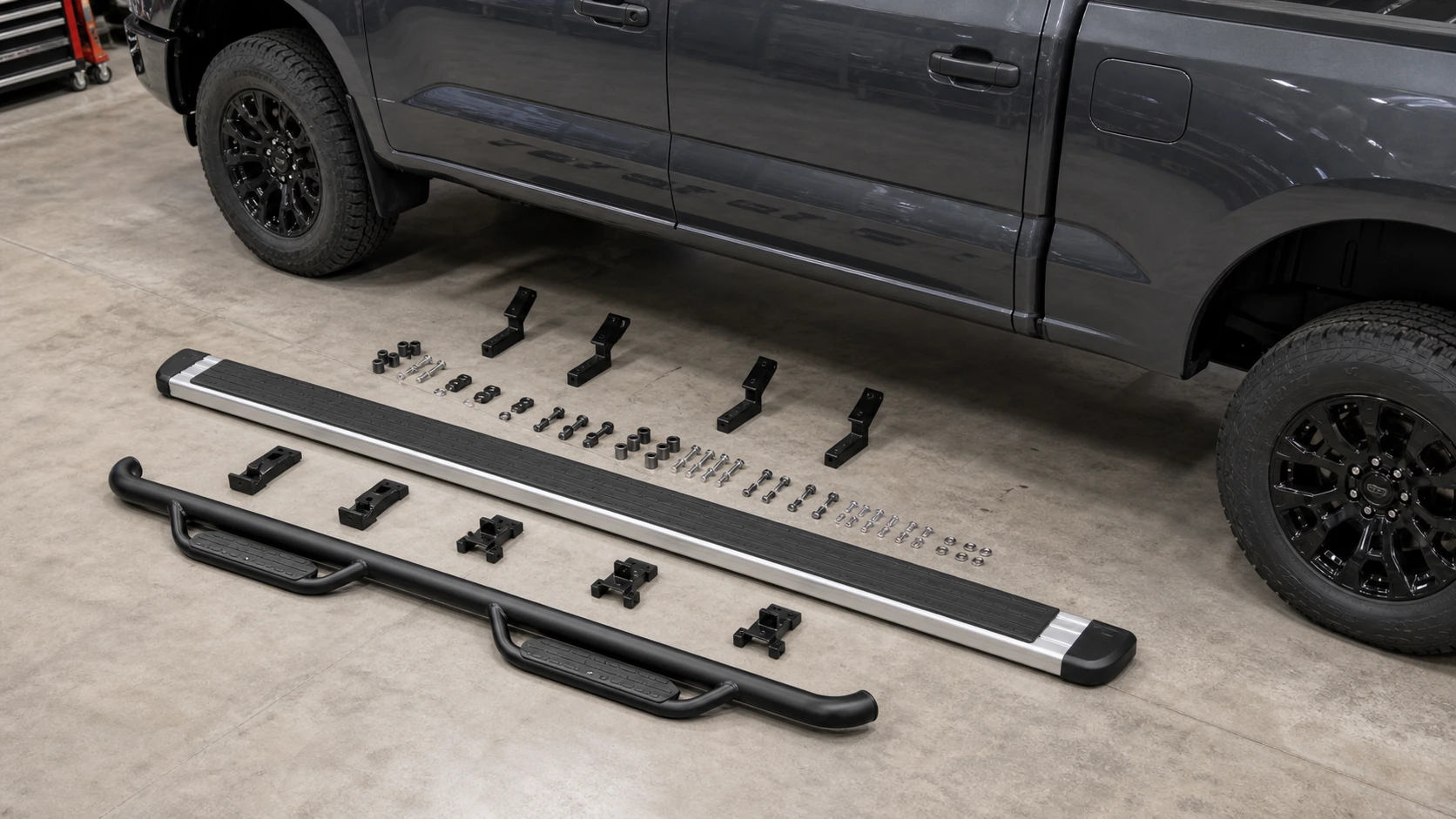
Why a similar-looking board is not proof of interchangeability
Many running boards are built around a common aluminum extrusion or steel tube. That can make two kits look interchangeable in a product photo. The hidden parts are more important: brackets must reach the correct reinforced points on the body, clear the pinch weld and rocker area, and hold the board at the intended height and angle. A board with the wrong bracket can sit crooked, interfere with the body, or place the fasteners where the truck was not designed to carry a step load.
Even a “no-drill” description does not mean universal fit. It normally means that the kit is designed to use the factory locations on the applications listed by its manufacturer. If those locations, the bracket offset, or the reinforcement hardware differ between a 1500 and a 2500, no-drill installation on one truck says nothing about the other.
When a listing groups both trucks together, compare the application table, cab length, mounting-point count, and bracket drawings. The fitment comparison covering running boards for Ram 1500 and 2500 is a useful second check because it focuses on the Ram 1500-to-2500 differences; the current manufacturer application chart and the instructions for the exact part number remain the final authority.
Identify the truck before measuring the step
Do not rely on the badge alone, especially when buying a used kit or shopping across a model-year transition. Start with the VIN, registration record, and driver-door label. The NHTSA VIN decoder can help confirm basic vehicle information, but the accessory maker’s application chart still needs to name the exact truck configuration.
- Record the full model year and series: Ram 1500, Ram 1500 Classic, or Ram 2500.
- Confirm the cab: Regular Cab, Quad Cab, Crew Cab, or Mega Cab as applicable.
- Record the bed length if the step extends behind the rear door.
- Photograph the factory mounting points along both rocker areas.
- Copy every part number from the board, brackets, motors, and hardware bags.
A seller’s phrase such as “came off a four-door Ram” is not enough. Ask for the donor truck’s year, series, cab, bed length, and the installation sheet. If the seller cannot identify the bracket kit, price the purchase as incomplete rather than assuming replacement brackets will be easy to find.
Model year and body family come before appearance
Running-board listings often cover a range of years, but that range should be read literally. A kit listed for an earlier body family should not be carried into a later one because the doors and rocker line appear close in length. The same caution applies to a Ram 1500 Classic and the newer 1500 body sold in an overlapping period.
Check the application in two places when possible: the manufacturer’s vehicle selector and the PDF or printed instruction sheet. The selector confirms the marketing application; the instructions reveal the actual bracket positions, hardware, and cab limitations. If the two sources disagree, pause the installation and contact the manufacturer with the part number and VIN.
For a broader example of why generation and cab checks matter, our Toyota Tundra side-step fitment guide uses the same disciplined sequence: identify the truck, match the bracket map, and only then compare finish and step style.
Cab length decides more than the overall board length
Cab-length boards normally provide a step below the front and rear doors. Wheel-to-wheel boards continue toward the rear wheel to improve bed-side access. A Crew Cab board therefore cannot be selected from overall length alone. Door opening locations, bracket stations, bed length, and the position of the rear step pad all matter.
Before ordering, measure from a fixed body reference point rather than the tire or bumper. Tires, suspension height, and bumper designs can change. Useful measurements include the distance between the first and last factory mounting stations, the door-sill span, and the desired board projection from the rocker. Compare your measurements with the manufacturer’s drawing, not a marketplace photo.
- Regular Cab: requires a short board and a bracket layout designed for the two-door body.
- Quad or Crew Cab: needs coverage and step-pad placement for both door openings.
- Mega Cab: should be treated as its own application whenever the manufacturer lists it separately.
- Wheel-to-wheel: must match both the cab and the bed length because the rear section is intended to reach the box.
The bracket kit is the real compatibility test
A complete running-board kit should include left and right boards, every position-specific bracket, the correct fasteners, any rivet nuts or reinforcement plates, and instructions that show where each bracket belongs. Some kits use brackets that appear nearly identical until their offsets are compared on a bench. Label the pieces before lifting the board into place.
Inspect the truck as carefully as the new hardware. Factory holes should be clean and undamaged. Remove packed dirt and surface corrosion without enlarging the openings. If threaded inserts are present, start the correct bolt by hand before supporting the board. A bolt that immediately binds may have the wrong thread or may be entering at an angle.
Never solve a mismatched bracket by stacking random washers, bending the mount, or drilling the rocker without instructions that specifically approve the modification. Those shortcuts can change the load path and leave the board unstable. If a universal kit legitimately requires drilling, follow its template, corrosion-protection procedure, hardware grade, and torque sequence exactly.
Fixed boards and power steps require different checks
Fixed boards are mechanically simpler, but they still need correct brackets, clearance, and a stable step surface. Power steps add a motorized hinge, wiring harness, sensors or control logic, and a stowed position under the body. A used power-step assembly is not complete merely because both boards are present.
Ram’s official owner information describes power side steps extending for easier entry and exit, remaining stored when the system is placed in Store mode, and retracting as vehicle speed rises. See the official Ram 2500/3500 power-side-step instructions for the operating behavior on the covered vehicles. That electronic integration is another reason not to assume a powered 1500 assembly can be transferred to a 2500.
Before buying a used powered kit, verify the motors, hinge assemblies, harness, modules, fasteners, and trim-specific requirements. Inspect the joints for play and confirm that the step can move through its full range without contacting the rocker, mud flap, or tire. Do not power an unknown motor with improvised wiring.
Ground clearance, step width, and real-world use
After fitment is confirmed, choose the style for the way the truck is used. A wide flat board gives a larger landing area for daily entry. A tubular side step can tuck closer to the body. An off-road-oriented board may preserve more clearance, while a wheel-to-wheel design can make it easier to reach a toolbox or cargo near the front of the bed.
Measure the lowest point of the proposed board and bracket relative to the rocker. On a truck that regularly travels on rutted roads, a low bracket can become the first point to contact an obstacle. On a family or work truck, step width, a slip-resistant surface, and predictable foot placement may matter more than maximum tuck.
The board’s advertised load rating is not the truck’s payload rating and does not prove bracket compatibility. Follow the vehicle loading information in the owner’s manual and on the certification labels. Also confirm the accessory’s own rating and installation requirements; do not use the running board as a jack point or recovery point unless the manufacturer explicitly designed it for that use.
Pre-installation checklist
- Exact model year, series, cab, and bed length recorded.
- Application chart names the complete truck configuration.
- Board and bracket-kit part numbers match the instructions.
- Left/right and front/middle/rear brackets are identified.
- All factory mounting points are present and undamaged.
- No interference with the pinch weld, rocker, mud flaps, tires, or wiring.
- Correct fastener grade, thread, torque values, and tightening sequence available.
- Power-step motors, harnesses, controls, and stow clearance confirmed when applicable.
- Board projection and step-pad positions align with the door openings.
Lay the complete kit out on the floor before starting. Compare the physical parts with the instruction diagram and count the fasteners. This takes a few minutes and prevents a half-installed board from being left unsupported while a missing bracket or incorrect bolt is located.
Installation sequence that protects alignment
- Park on a level surface, secure the truck, and use appropriate eye protection.
- Clean and inspect every intended mounting location.
- Install the brackets finger-tight in their specified positions.
- Support the board and start all board-to-bracket fasteners by hand.
- Center the step pads under the door openings and verify body clearance.
- Tighten in the sequence and to the torque values supplied for the exact kit.
- Open every door, turn the steering from lock to lock, and inspect tire and mud-flap clearance.
- Step on the board at each bracket station and listen for movement or contact.
- Reinspect the hardware after the interval specified by the manufacturer and after severe road use.
If road debris and wheel-well exposure are part of the concern, our wheel-well cover guide explains a separate fitment check for liners, fasteners, and tire clearance. Treat that as a different system; a wheel-well accessory should never be used to brace or conceal an incorrect running-board bracket.
Buying a used take-off kit
Used factory take-offs can be a good value when every component is identified. Ask the seller to photograph the part labels and lay the brackets beside the boards. Compare the bracket count with the installation sheet. Surface wear on the step pad is usually easier to evaluate than hidden damage to a bent bracket or powered hinge.
Reject a kit with elongated holes, cracked welds, severely corroded hardware, bent mounting ears, cut wiring, or missing position-specific brackets unless the manufacturer sells the exact replacement components for your truck. A cheap board becomes expensive when the correct hardware is unavailable.
Do not assume that buying a new 2500 bracket kit will automatically convert a 1500 board. That is safe only when the board manufacturer explicitly lists the same board assembly with the correct replacement brackets for both applications. Matching finish, tube diameter, or overall length is not enough.
Frequently asked questions
Can I reuse the board and buy different brackets?
Only when the manufacturer identifies that exact board as a shared component and provides a bracket kit for the destination truck. Otherwise, the board-to-bracket attachment points may differ even if the board length looks correct.
Does Crew Cab mean the same fit on a 1500 and 2500?
No. Crew Cab describes the passenger compartment, not the complete chassis, rocker structure, or bracket map. The application still has to name the truck series and model-year range.
Are wheel-to-wheel boards harder to transfer?
They add another variable because the rear section is positioned for bed access. The cab and bed length must both match, and the rear bracket needs the correct mounting location.
Can a shop drill new holes to make the kit fit?
Drilling is appropriate only when the exact kit’s instructions call for it and provide a template, hardware specification, corrosion protection, and torque values. Drilling simply to adapt the wrong bracket is not a fitment solution.
What if the listing says the board fits “all Ram trucks”?
Treat that as an incomplete claim. Ask for the application chart and instructions. A reliable listing identifies series, years, cab, board length, and kit part number.
What should I check after installation?
Confirm the board is level, every foot lands on a stable surface, doors and tires clear the step, brackets do not touch the body, and all hardware remains tight. Follow the manufacturer’s inspection and re-torque schedule.
Conclusion
Ram 1500 and 2500 running boards should be treated as model-specific accessories, not interchangeable trim. The correct decision comes from the full application: model year, body family, cab, bed length, board coverage, mounting points, and bracket kit. If any one of those items is missing, stop before drilling or ordering more hardware.
A careful fitment check protects more than the return window. It keeps the step aligned with the doors, preserves ground and tire clearance, and ensures that the load reaches the mounting locations the kit was designed to use.