
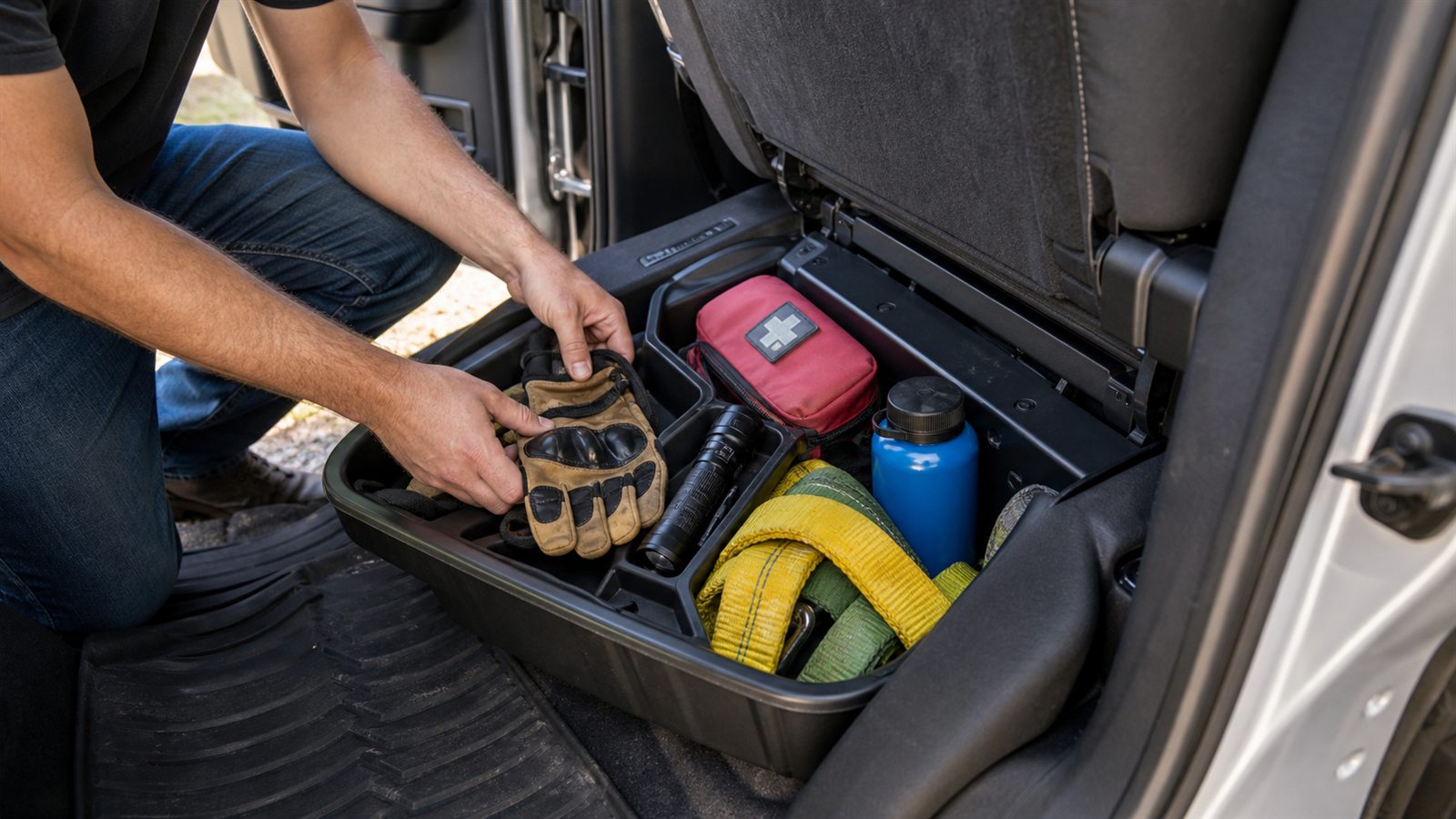
Short answer: reset the truck cab after a summer road trip by emptying every loose item, separating emergency gear from everyday cargo, checking anything affected by heat or moisture, and returning only equipment that has a secure home. The goal is not a showroom-clean interior. It is a cab where the driver can reach the essentials without loose objects competing for footwell, seat, or under-seat space.
Long trips have a way of turning a pickup cab into temporary storage. Chargers migrate between seats, wet towels get pushed behind the bench, snacks stay in door pockets, and roadside tools end up mixed with travel bags. A careful reset takes less time than repeatedly searching through that clutter, and it makes the next trip easier to prepare for.
Start with a complete unload
Park in a dry, shaded place and remove everything that is not permanently attached. Work one zone at a time: front footwells, console, door pockets, rear floor, seat-back pockets, and the space below the rear bench. Put the contents into four groups:
- Return to the truck: equipment that belongs in the vehicle year-round.
- Move indoors: luggage, paperwork, electronics, and heat-sensitive supplies.
- Clean and dry: floor mats, straps, gloves, towels, and reusable containers.
- Discard or replace: damaged packaging, expired supplies, leaking bottles, and dead batteries.
This first pass also exposes damp carpet, grit around seat rails, and items that may interfere with a seat latch. Vacuum before returning gear, and let any damp area dry fully instead of covering it with a storage bin.
Rebuild the emergency kit as a working system
The National Highway Traffic Safety Administration summer-driving guide recommends carrying essentials such as a phone charger, first-aid kit, flashlight, jumper cables, tire-pressure gauge, jack, gloves, basic tools, water, nonperishable food, and maps. Use that list as a check rather than assuming the kit is complete because a bag is still in the truck.
Open the kit and inspect each item. Test the flashlight. Check cables and tool handles for damage. Replace used first-aid supplies. Confirm that the jack and its handle match the truck. Rotate water, food, and batteries according to their labels. FEMA’s Ready.gov preparedness guidance also points drivers toward a portable car kit, which is a useful reminder that a kit should be reviewed, not merely stored.
Keep the kit contained in one labeled bag or bin and place it where it can be reached without unloading the entire cab. Heavy tools should sit low and should not be able to slide into passenger foot space.
Separate daily-use items from roadside equipment
Daily items and emergency equipment have different jobs. Chargers, sunglasses, parking passes, and a small cleaning cloth belong near the front seats. Jumper cables, work gloves, tow accessories, and a tire gauge can live farther back. Mixing the two groups creates a deep pile that has to be searched every time a cable or document is needed.
Use small, clearly defined containers rather than one oversized tote. A soft pouch works for cables. A rigid lidded bin can contain tools. A washable tray can hold muddy straps or gloves until they can be cleaned. Leave airbag zones, seat tracks, pedals, and child-seat anchors unobstructed.
Check what summer heat may have changed
A parked cab becomes a harsh storage environment. Remove anything whose label calls for controlled temperatures, including medicines and certain batteries, adhesives, aerosols, and electronic devices. Do not assume a closed console protects an item from heat. If packaging has swollen, leaked, softened, or lost its seal, follow the manufacturer’s disposal guidance.
Also look for melted food, sunscreen residue, and moisture trapped beneath rubber mats or under-seat bins. Clean spills before they attract dirt or damage trim. If the truck carried beach equipment, wet clothing, or coolers, inspect seams and carpet edges for lingering moisture.
Use under-seat space without blocking the seat
Rear under-seat space is useful only when the organizer fits the exact cab and seat layout. Before reinstalling a bin, raise and lower the seat several times. Verify that latches close normally, mounting points remain accessible, and the bin does not push against wiring, a factory subwoofer, or floor-mat edges.
Our Silverado under-seat storage fitment guide explains why Crew Cab and Double Cab systems are not automatically interchangeable. If the organizer was removed for the trip, check every strap and fastener before putting it back.
Give towing and cargo gear its own inventory
Road trips often leave tie-downs, hitch pins, adapters, and work gloves scattered between the cab and bed. Count the straps, inspect webbing and hooks, and retire anything cut, badly abraded, or corroded. Clean dirt from hitch accessories before storing them in a sealed cabin compartment.
If tailgate hardware was used repeatedly during the trip, add it to the inspection instead of treating the cab reset as a purely cosmetic job. The site’s tailgate-assist guide covers the hardware and fitment points worth checking when tailgate movement no longer feels consistent.
Finish with a five-minute access test
Sit in the driver’s seat after everything is returned. Without moving loose cargo, confirm that you can reach the phone charger, registration documents, flashlight, and first-aid kit. Check that pedals and seat tracks are clear. Fold or lift the rear seat and make sure nothing catches. Then walk around the truck and confirm that the roadside kit can be reached from the safest practical side.
A good truck-cab reset leaves visible empty space. That is not wasted capacity; it is room for passengers, a clear route to essential equipment, and a simple baseline for the next trip. Make the same short review after any long drive, muddy job, or wet-weather weekend so that temporary cargo does not quietly become permanent clutter.