
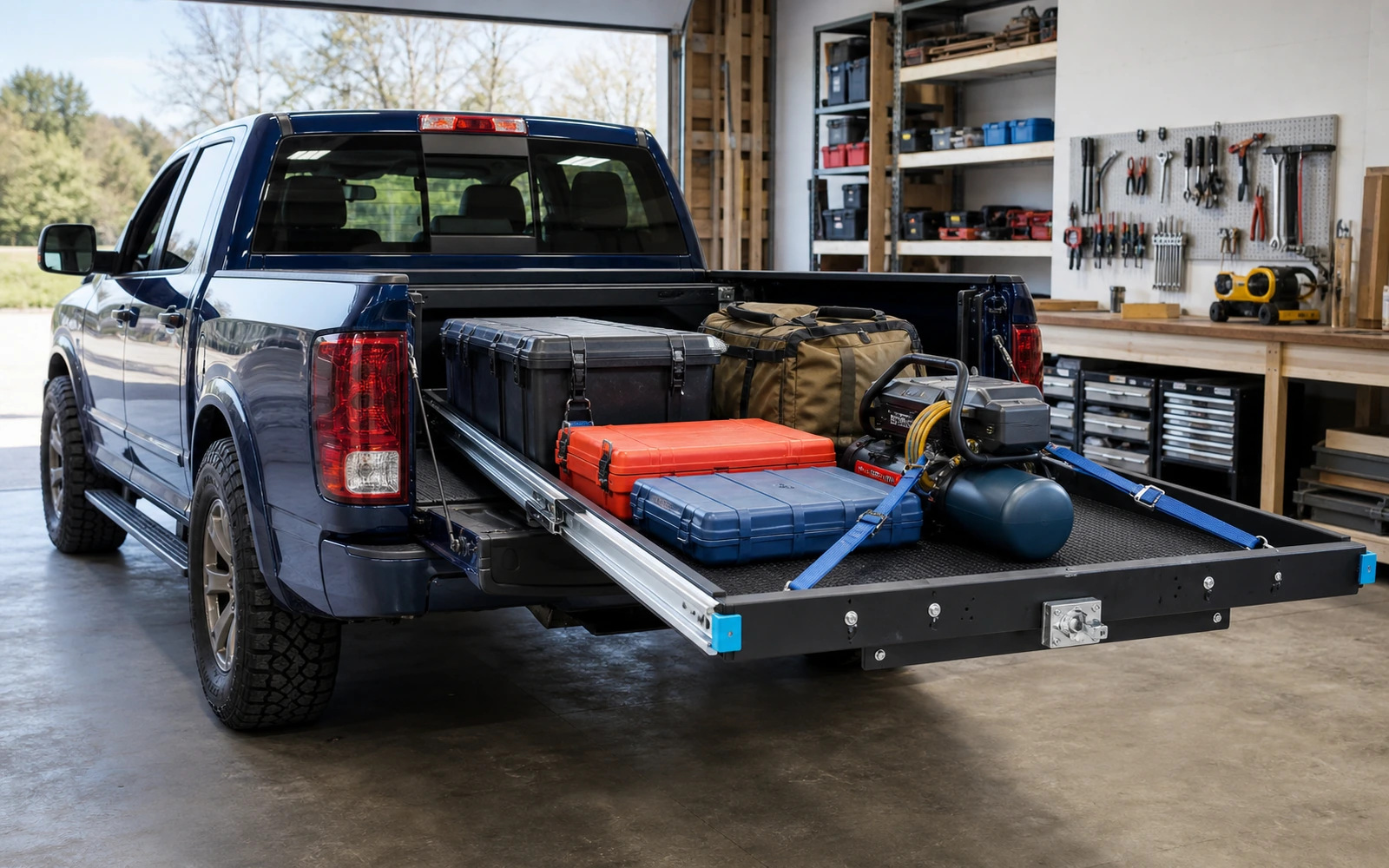
The 78 x 48 version offers the same 1,500-pound contractor class with a slightly longer deck. That extra length can be useful in a standard bed but may create tailgate or cab-end clearance issues in a shorter box.
Fitment first
What to confirm before buying
Verify a clear 78-inch length and 48-inch width at the platform's installed height. Measure with the tailgate closed and open, then check diagonals to reveal a bed or liner that narrows or sits out of square. Include the front bulkhead contour, wheel-well spacing, tailgate step, bed lights, power outlets, cargo cleats, and any tonneau or rack clamps. The deck must clear those features while moving, not merely while parked in its stowed position. Do not assume that every nominal 6.5-foot bed provides the same usable 78 inches. Confirm part 15-7848-CG or model 157848CG on the product and installation instructions, because width and length variants use different mounting geometry. The 166-pound listed weight must be added to other permanent accessories before estimating cargo. For a commercial layout, an axle-scale weight for the empty fitted truck provides a stronger baseline than a generic trim-level payload figure.
Product at a glance
| Product | Bedslide 1500 Contractor |
|---|---|
| Deck | 78 x 48 inches |
| Rated tray capacity | 1,500 lb |
| Use | Contractor and service cargo |
How this accessory works in practice
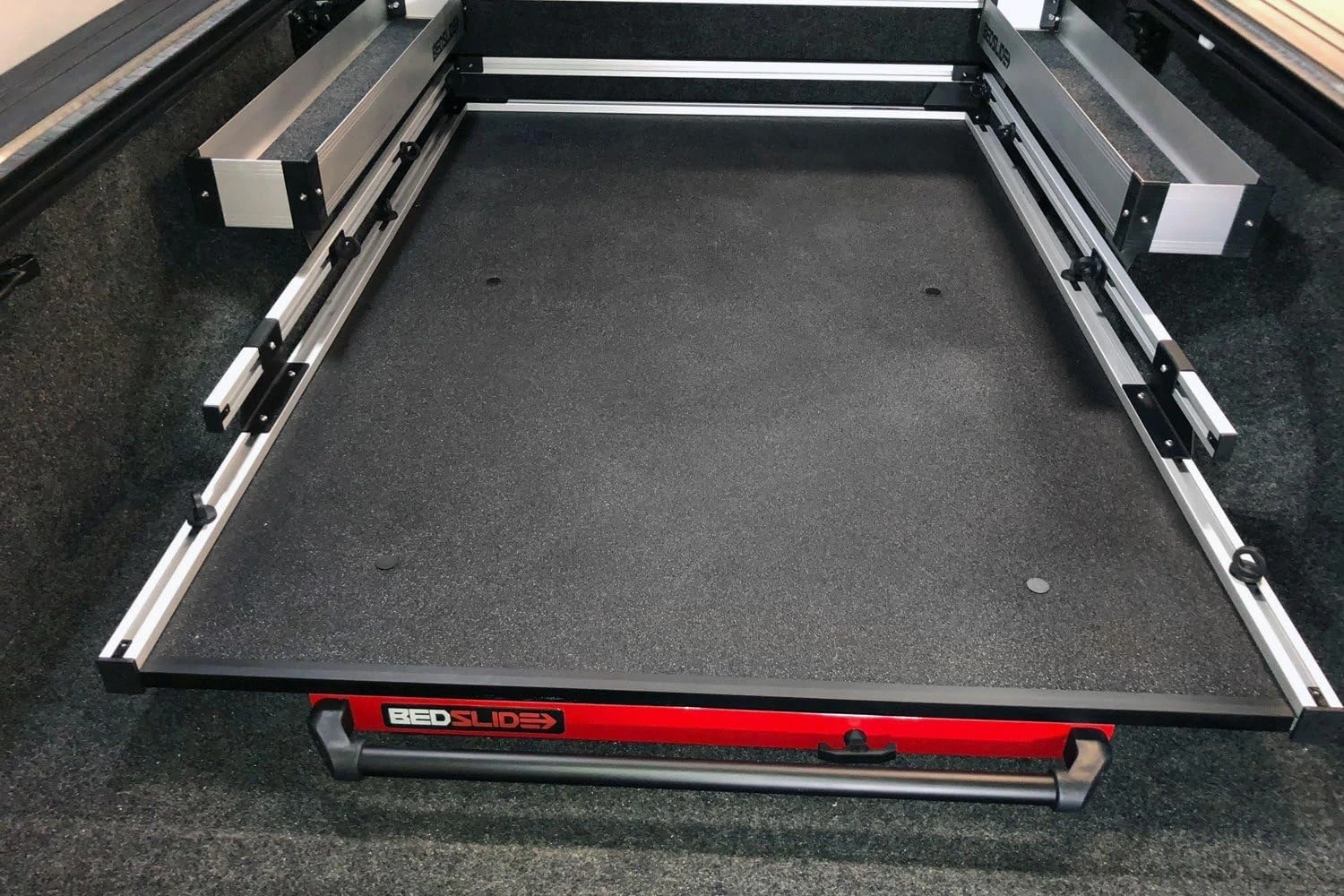
The Bedslide 1500 Contractor covered here uses a 78-by-48-inch deck and a 1,500-pound evenly distributed capacity. Product identifiers include part 15-7848-CG and model 157848CG; the listed platform weight is 166 pounds. Like the 75-inch Contractor, it uses a weather-resistant composite deck, Bedtrax T-slots, four D-ring tie-down locations, and multiple pull-out locking positions. The extra three inches of length are modest on paper but meaningful in a bed where the tailgate, front wall, or liner already leaves little clearance. This configuration is aimed at standard-bed service layouts that benefit from a longer continuous deck for cases, parts bins, survey equipment, or recreational systems. The old page name referenced CargoGlide CG1500XL, whose archived description claimed 100 percent extension and different construction details. Those legacy CG1500XL claims must not be automatically assigned to the 78-by-48 Bedslide. The replacement and the former product share a load class and purpose, not necessarily identical extension geometry or hardware.
Daily use and ownership
The longer deck is useful when cases or bins are arranged in full-length rows and the operator wants fewer small gaps at the front wall. A mobile technician might keep frequently used drawers near the tailgate, larger diagnostic cases in the middle, and infrequently used stock toward the cab. Bedtrax slots and the four D-rings can support a repeatable restraint plan, but every container still needs a tie-down appropriate to its mass. Place dense equipment across the deck rather than building a heavy tailgate-end cluster. Select the nearest useful pull-out lock, keep the truck stationary, and control the platform on sloped pavement. The old CG1500XL's 100 percent-extension statement is not evidence that this Bedslide moves its entire 78-inch deck outside the bed; use the Bedslide manual for extension and lock positions. Fully stow and latch the tray before travel, then check that no strap tail can enter the slide mechanism.
Installation and setup
Dry-fitting matters more on the 78-inch version because there is less tolerance for front-to-rear error. Set the empty frame in the bed, center it between the wheel wells, and operate the tailgate while checking both straight and diagonal clearances. Mark mounting locations only after confirming access to the release handle and all planned tie-downs. Inspect the underside for the fuel tank, filler neck, wiring, brake lines, exhaust and emissions parts, frame flanges, and spare-tire mechanism. Follow the part-specific template, structural backing method, bolt grade, and torque sequence. Keep the rails parallel and avoid using a thick bedliner as a spacer unless the instructions provide for it. Cycle the empty deck through every locking position, then repeat with a low, evenly distributed test load. Watch the front edge, face plate, and 48-inch sides for contact. The 166-pound assembly is not a one-person placement task; support it securely so installation does not begin with a dropped frame or damaged tailgate.
Care and maintenance
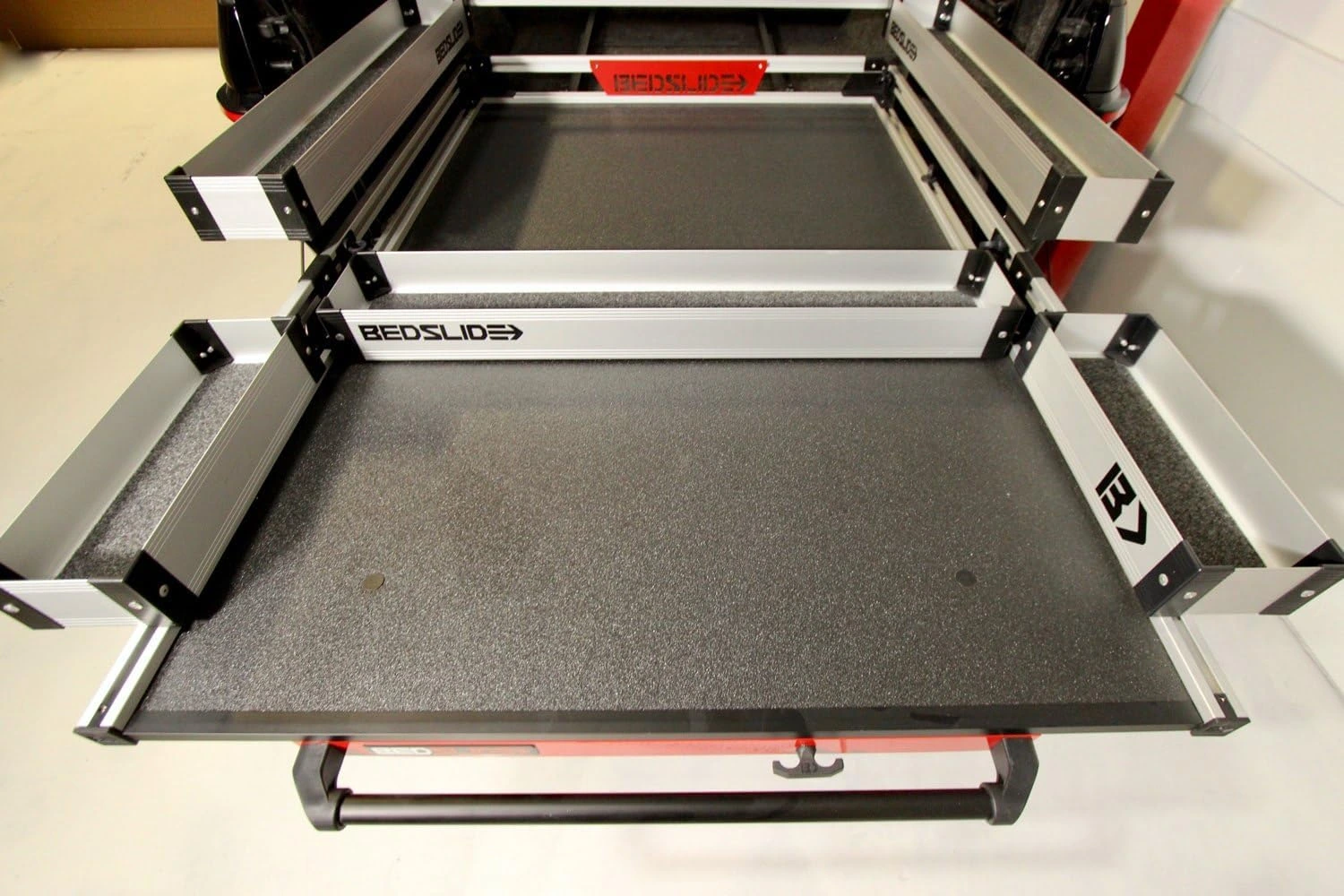
Clean grit from the composite deck, T-slots, rollers, and latch openings before it becomes packed into the mechanism. Rinse corrosive residue, inspect coating at metal edges, and keep drainage paths around the bed open. Check the D-rings, guard rails, frame fasteners, release handle, lock positions, vehicle mounts, and cargo straps. Use only the lubrication method specified for this model. If one side starts ahead of the other, or a lock engages differently under load, unload the tray and inspect alignment rather than compensating with extra force. Periodically confirm that added tools have not pushed the truck beyond its planned payload or rear-axle margin.
Buy it when
- Choose the 78-by-48 Contractor when the measured bed supports the full footprint and the extra three inches improves a real storage layout, such as long rows of service cases or a near-full-length recreation module. It suits buyers who need a 1,500-pound evenly distributed tray class and can account for the 166-pound platform in the vehicle load plan.
Skip it when
- Choose the 75-inch version when 78 inches leaves uncertain tailgate or bulkhead clearance, or when the longer deck provides no usable storage gain. Skip this class if cargo is light enough for a lower-capacity slide, if the truck cannot spare the payload, or if true 100 percent extension is mandatory but not documented for the selected Bedslide.
Frequently asked questions
What is the practical difference between the 75-inch and 78-inch Contractor trays?
Both are 48 inches wide and carry a stated 1,500-pound evenly distributed rating, but the longer version adds three inches of deck. That can complete a full-length bin layout, yet it also reduces fitment margin. Select from measured usable floor length, tailgate clearance, and mounting access rather than capacity, which is the same.
Does the 78-inch Bedslide have the CG1500XL's 100 percent extension?
That conclusion is not supported by the supplied records. The 100 percent figure belongs to the archived CargoGlide CG1500XL description. The Bedslide listing confirms multiple pull-out locking positions but does not make the legacy unit's extension claim transferable. Check the Bedslide installation and operation manual for the exact travel specification.
Can 1,500 pounds be loaded at the tailgate end for easier access?
No. The rating is stated for weight distributed over the deck. Concentrating the load at the rear increases leverage while the tray is extended and can overload the slide, bed mounts, rear axle, or tires. Place dense items low and across the platform, and remain below every applicable vehicle and component limit.
Why check both straight measurements and bed diagonals?
A 78-inch deck has little room to tolerate a liner that is shifted, a bed that is not square, or a bracket protruding at one corner. Equal diagonals help verify the available rectangle before holes are made. They also support parallel rail installation, which is necessary for consistent rolling and latch engagement.
Related fitment guides
- Bedslide 1500 Contractor 75 x 48 Sliding Truck-Bed Organizer
- Bedslide 2000 Heavy-Duty 78 x 48 Truck-Bed Organizer
- BAKFlip MX4 448207 for Ram 1500 5 ft 7 in Bed: Fitment Review
Technical reference
Application and technical details were checked against Heavy-duty sliding-tray product record. Use the manufacturer application data and the vehicle’s own measurements as the final fitment check.