
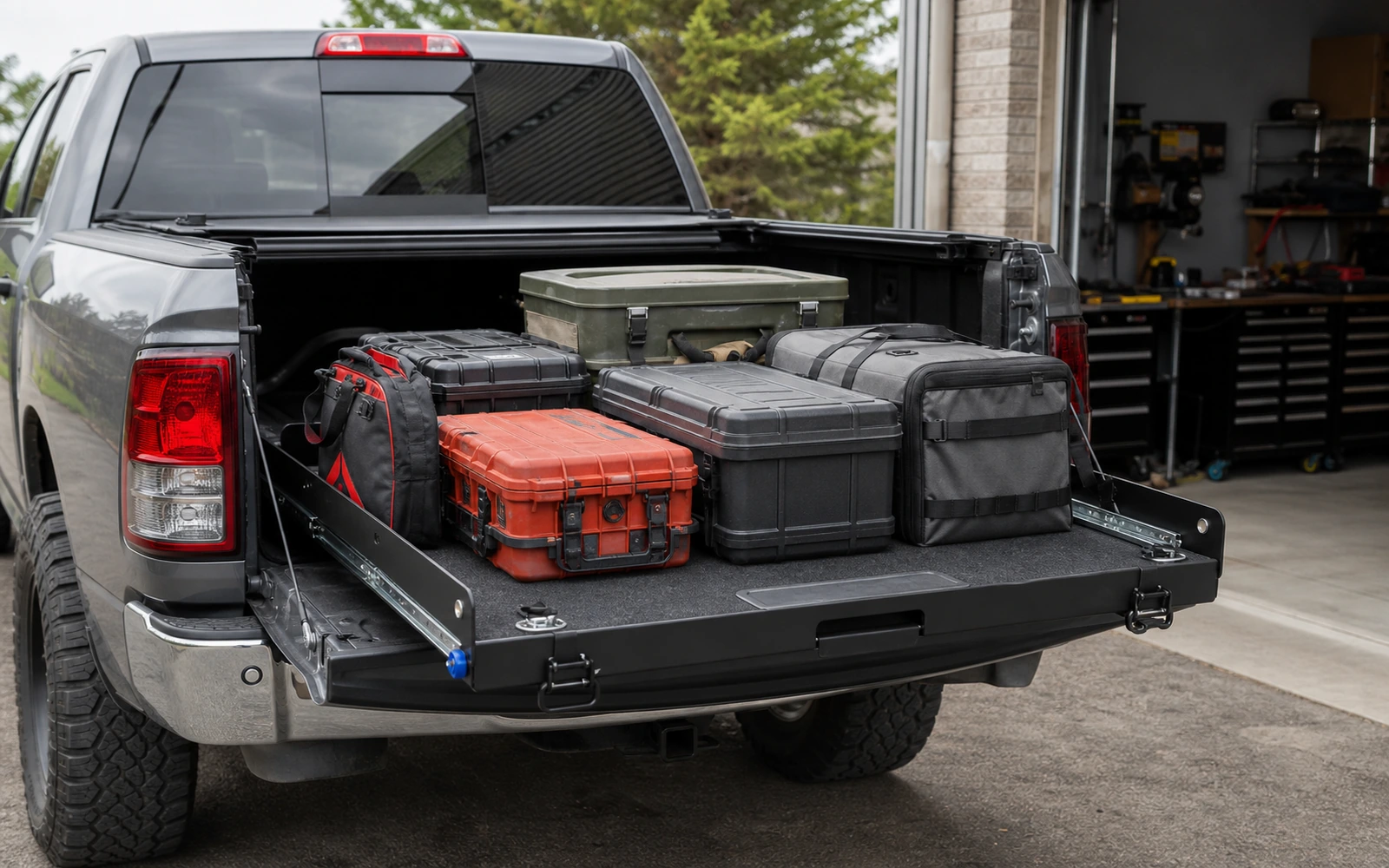
The CG1200 sits between light recreational slides and heavier contractor trays. It is most useful for owners who routinely unload tools or camping gear from the front half of a pickup bed.
Fitment first
What to confirm before buying
The CG1200 was offered in more than one width and length, so the model-family name alone cannot answer whether a used or old-stock unit fits. Record the tray's exact outside length, outside width, mounting-hole pattern, rail height, and extension specification. Then measure the usable bed floor between the wheel wells, from the front wall to the closed tailgate, and through the tailgate opening. The archived page associated variants with Silverado and Sierra crew-cab short beds, F-150 SuperCrew super-short beds, the Ford Raptor, 2009-2015 Ram 1500 short beds around 5.7 feet, and Nissan Titan crew-cab short beds around 5.5 feet. Treat that list as a set of historical applications, not a universal interchange chart. Bedliners, gooseneck hardware, tonneau clamps, factory cargo systems, wheel-well shapes, and tailgate steps can reduce usable space. Verify that structural mounting locations are accessible and that the platform clears the tailgate through its full travel.
Product at a glance
| Model family | CargoGlide CG1200 |
|---|---|
| Rated class | 1,200 lb family |
| Purpose | Sliding truck-bed cargo access |
| Selection variables | Width, length and mounting surface |
How this accessory works in practice
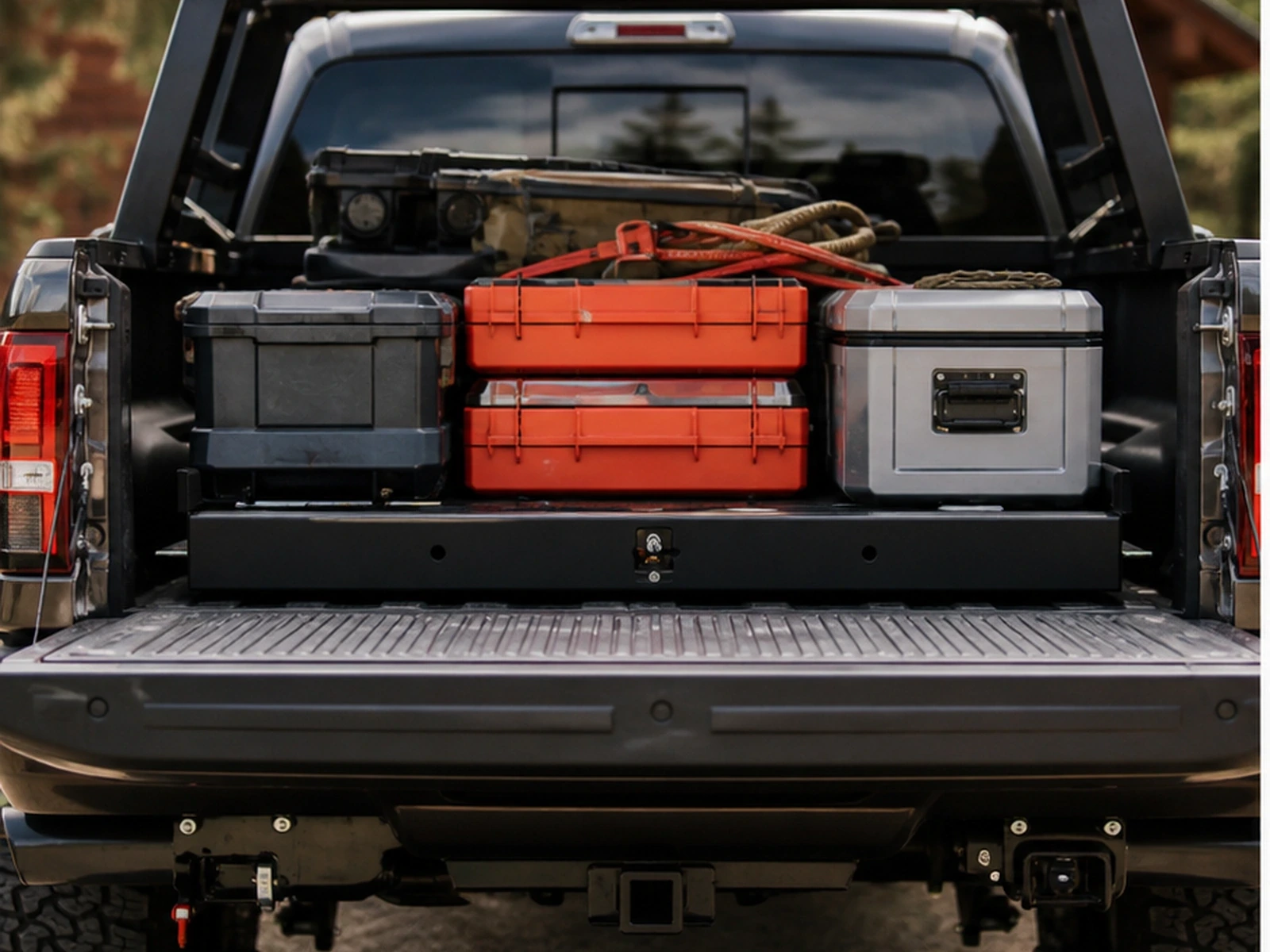
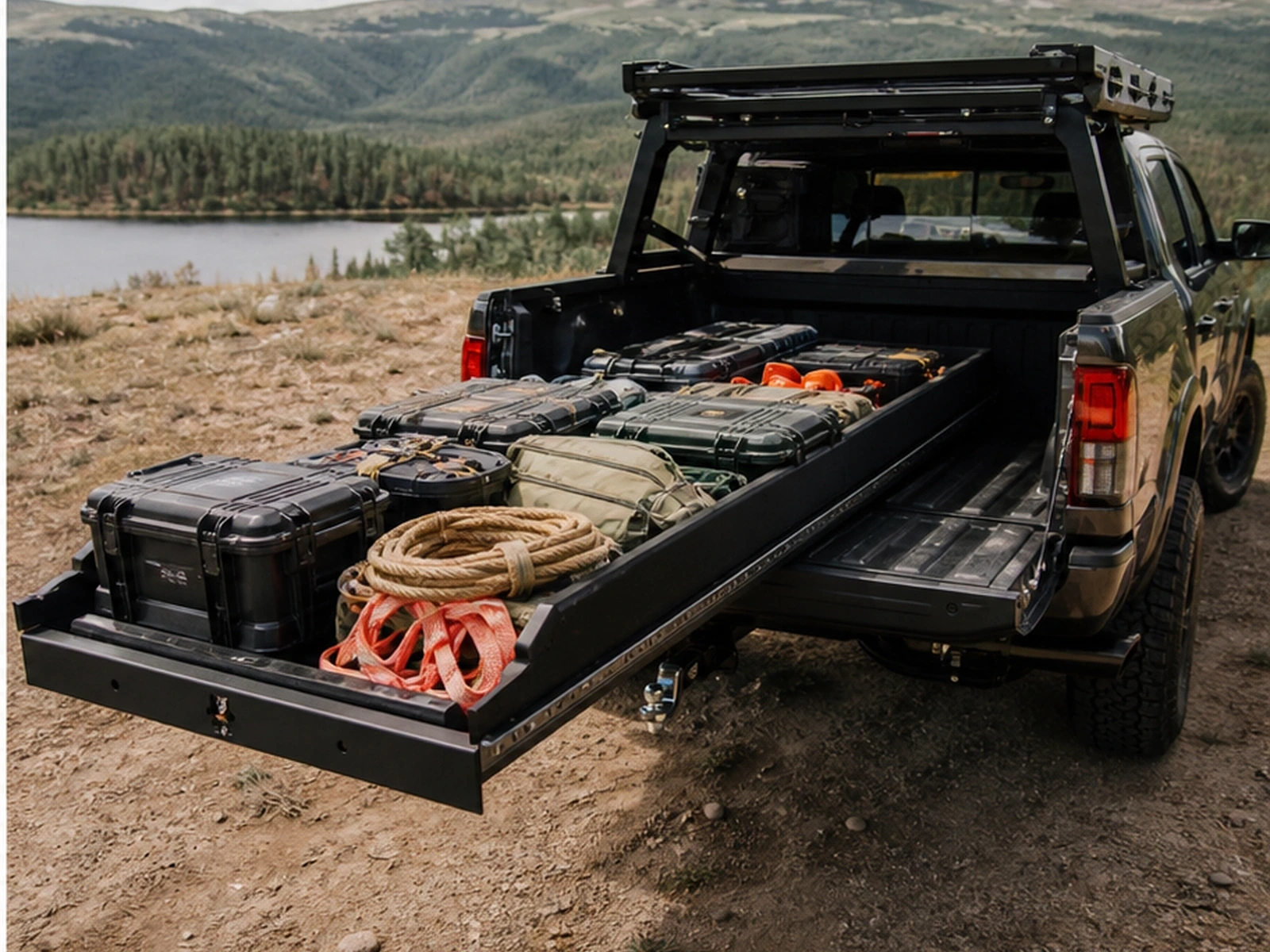
CargoGlide CG1200 is best understood as a 1,200-pound sliding-platform family rather than one universal tray. The archived product material describes a sturdy steel frame, a burnished aluminum face plate, approximately 70 to 75 percent extension, adjustable tie-down eyebolts, and sealed bearing support. Its purpose is to bring equipment stored near the cab into reach at the tailgate, reducing the need to climb over other cargo. The 1,200-pound class places it between the lighter CG1000 and the 1,500-pound contractor-oriented models, making it relevant to mixed recreational and service loads. Examples include camping bins, recovery equipment, portable tools, event supplies, and organized household cargo. It also adds a large permanent assembly above the bed floor. That assembly consumes payload, raises the cargo floor, and changes how weight acts on the rear axle when the platform is extended. The tray rating must therefore be read as a component limit, not as permission to load 1,200 pounds into any truck.
Daily use and ownership
A CG1200 is a practical middle choice when cargo is too heavy or too frequently accessed for loose bins, but a 1,500- or 2,000-pound platform would consume unnecessary payload. Arrange dense cases low and near the centerline, distribute weight across the deck, and use the four adjustable tie-down points described in the archived specifications. Keep tools and containers inside the side rails instead of relying on friction from the deck surface. Release the latch only while the truck is stationary, preferably on level ground, and control the platform as it moves. A 70 to 75 percent extension brings most of the deck within reach, but it does not place every inch beyond the tailgate. Reserve the cab-end section for items that are needed less often. Before driving, return the tray fully into the bed, confirm the latch has engaged, and independently secure the cargo. The slide mechanism is for access; it is not a travel restraint.
Installation and setup
Remove loose mats and cargo, then dry-fit the exact CG1200 variant before drilling or bolting. Confirm wheel-well clearance, closed-tailgate clearance, handle access, and the height needed for the tray to pass over the tailgate. The archived design includes height adjustment for different tailgate situations, but adjustment should remain within the unit's installation instructions. Mark structural attachment points only after inspecting below the bed for the fuel tank, filler path, wiring harnesses, brake lines, spare-tire hardware, and frame members. A convenient hole location from above can be hazardous underneath. Use the supplied backing hardware or the specified mounting kit, keep both slide rails parallel, and tighten fasteners evenly so the bearings are not placed in a bind. Cycle the empty tray through every latch position before adding weight. Then test with a modest, evenly distributed load and recheck that the tailgate, face plate, rails, and tie-downs remain clear. A liner is not a structural mounting surface.
Care and maintenance
Sweep abrasive grit from the deck and tracks, wash road salt from exposed steel and aluminum surfaces, and repair coating damage before corrosion spreads. Inspect the sealed bearings, side-thrust support, latch, handle, mounting bolts, tie-down eyebolts, side rails, and deck edges for looseness or deformation. Sealed bearings should not be flooded with an unapproved lubricant; follow the unit manual if lubrication is specified. Recheck mounting hardware after the first loaded cycles and whenever rattling, uneven travel, or a change in latch engagement appears. Stop using the tray until a bent rail or damaged restraint is corrected.
Buy it when
- The CG1200 fits a buyer who has verified the exact tray dimensions and mounting pattern, needs more capacity than a 1,000-pound recreational slide, and regularly reaches equipment stored forward of the wheel wells. It is a sensible match for mixed camping, field-service, recovery, or event cargo that can be spread across the deck and tied down.
Skip it when
- Pass on it when the seller cannot identify the tray size, mounting kit, or complete hardware; when the truck's remaining payload cannot absorb the platform and planned cargo; or when a toolbox, fifth-wheel hitch, tailgate feature, or bed-rack mount occupies the same space. Choose a full-extension professional tray when cab-end access is the overriding requirement.
Frequently asked questions
What are the exact dimensions of a CargoGlide CG1200?
The source material describes CG1200 as a family sold in multiple width and length combinations, not as a single fixed deck. Ask for the unit label and measure the actual tray, including its frame and handle. Fit must be checked against the usable bed floor and tailgate opening, not just the truck's nominal bed category.
Can any pickup carry the full 1,200-pound tray rating?
No. The 1,200-pound figure is the platform family's rated class. The truck must also carry the platform itself, occupants, accessories, and other cargo without exceeding payload, GVWR, rear GAWR, or tire limits. Weight should be distributed across the deck, and the lowest applicable vehicle or component limit controls.
How far does the CG1200 slide out?
The archived specifications state roughly 70 to 75 percent extension, with variation possible by configuration. That brings most cargo toward the tailgate but leaves part of the deck supported inside the bed. Verify the exact unit's manual and latch positions instead of applying the family range as a precise measurement to every variant.
Does the historical truck list guarantee fit on those models?
No. The listed Silverado, Sierra, F-150, Raptor, Ram, and Titan configurations show that matched variants existed. They do not show that every CG1200 tray fits every listed truck. Bed length, width, liner, factory cargo hardware, mounting pattern, and included brackets still have to match the specific vehicle and unit.
Related fitment guides
- CargoGlide CG1000 Sliding Truck-Bed Tray Review
- Bedslide 1500 Contractor 75 x 48 Sliding Truck-Bed Organizer
- Bedslide 1500 Contractor 78 x 48 Sliding Truck-Bed Organizer
Technical reference
Application and technical details were checked against CargoGlide CG1200 specification sheet. Use the manufacturer application data and the vehicle’s own measurements as the final fitment check.